

Most people assume that posting personal photos or sharing travel memories on social media automatically makes their account non-commercial. That assumption is wrong, and it matters more than you might think. Understanding what is non-commercial social media shapes your content choices, your privacy exposure, and which platforms actually serve your interests. This guide breaks down the real definition, shows you where the lines blur, and introduces ethical platforms built specifically for personal and cultural storytelling across Europe.
Table of Contents
- Defining non-commercial social media: key distinctions
- Privacy-focused and ethical alternatives: Pixelfed case study
- Understanding the nuances: when personal becomes commercial
- Non-commercial social media in practice: content guidelines and community norms
- Tips for choosing and engaging with non-commercial social media platforms
- Why the conventional view of social media misses the value of non-commercial networks
- Explore non-commercial social media with Experience.eu
- Frequently asked questions
Key Takeaways
| Point | Details |
|---|---|
| Clear definition matters | Non-commercial social media means purely private use without any economic purpose or advertising at all. |
| Ethical platform benefits | Platforms like Pixelfed offer decentralized, ad-free, and privacy-focused social networks ideal for personal sharing. |
| Commercial blurs with personal | Even indirect economic aims like branding or affiliate links turn accounts into commercial entities. |
| Content guidelines ensure safety | Non-commercial social media often enforces respectful, educational, and family-friendly content policies. |
| Community choice impacts experience | Selecting the right instance or platform and understanding its norms is key to meaningful non-commercial engagement. |
Defining non-commercial social media: key distinctions
To understand the value of non-commercial social media, we first need to grasp how it is defined legally and practically.
Non-commercial social media use means purely private accounts without advertising, product recommendations, or commercial gain. That definition sounds simple. In practice, it rules out a surprising number of accounts that most people think of as "personal."
Here is what disqualifies an account from being truly non-commercial:
- Advertising or sponsored content, even occasional or low-paid posts
- Affiliate links or discount codes, regardless of how rarely you use them
- Free product promotions, where a brand sends you something in exchange for a post
- Brand awareness activity, such as tagging your employer's products in your photos
- Creator or business account settings, which signal commercial intent to both the platform and copyright holders
The distinction also matters for copyright and licensing. Music you use in a personal story reel may be covered under a standard license, but the moment your account has commercial elements, that coverage disappears. Checking your freelance social media definitions becomes essential if you ever mix paid work with personal posting.
"Only purely private accounts with no advertising, product recommendations, commissions, or other remuneration qualify as non-commercial." — Osborne Clarke
One overlooked grey area involves SEO-driven social activity. If you are building a following specifically to drive traffic to a personal blog that carries ads, even that goal tilts your account toward commercial territory.
Privacy-focused and ethical alternatives: Pixelfed case study
Having defined non-commercial use, let's explore real-world ethical platforms like Pixelfed that embody these principles.
Pixelfed is an open-source, photo-sharing platform with no ads and no data tracking. It runs on the ActivityPub protocol, which means it connects with other networks like Mastodon across a broader ecosystem called the Fediverse. Pixelfed operates on over 100 independent instances, with no ads or data tracking, enabling decentralized photo sharing through a shared protocol.
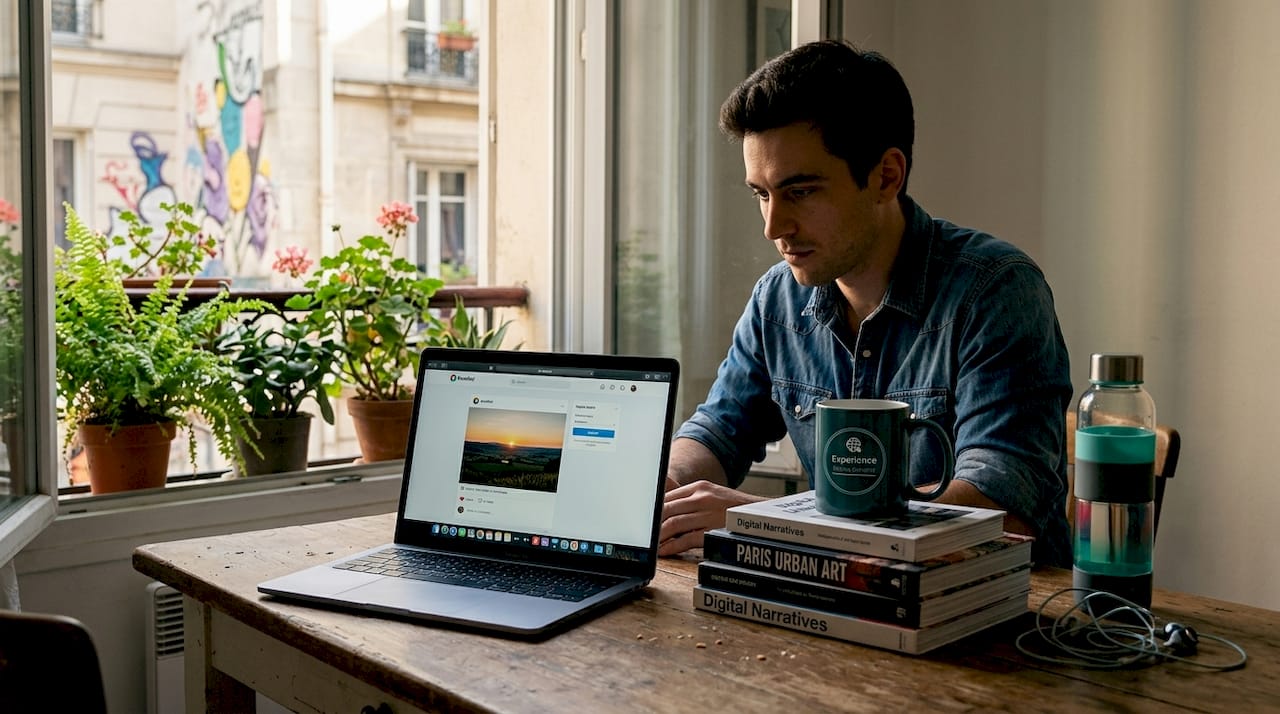
What does "decentralized" actually mean for you as a user? Instead of one company owning the entire platform, many independent servers run their own versions of Pixelfed. Each server, called an instance, has its own moderators, community rules, and character. You pick the one that fits your values.
Key features that make Pixelfed a strong non-commercial social platform:
- No advertising feed, so what you see is what your community actually posts
- No algorithmic manipulation pushing viral or sponsored content in front of you
- Open-source code, which means anyone can audit how your data is handled
- Data stays local, within the instance you choose rather than flowing to one central corporation
- Cross-network connections, so you can follow photographers on Mastodon or other Fediverse platforms
"Pixelfed offers a more ethical way to connect online, with content ownership and control returned to the user." — All Things Open
Pro Tip: Before picking a Pixelfed instance, read its "About" page. Some are general photo communities; others focus specifically on landscape photography, street photography, or regional European culture. Finding the right fit makes a big difference in your experience.
If you are newer to this ecosystem, the free social platforms guide for young Europeans covers a broader range of options and explains the basics of decentralized networking. For comparison with centralized platforms, understanding how a service like Twitter operates helps you appreciate exactly what non-commercial platforms remove from the equation.
Understanding the nuances: when personal becomes commercial
To better navigate social media, it is crucial to understand when personal sharing crosses into commercial territory.
The legal threshold is lower than most people expect. Accounts become commercial as soon as they pursue economic purpose indirectly, such as increasing brand awareness or using affiliate links occasionally alongside personal posts. "Occasionally" is the critical word there. You do not need to be running a full influencer operation for the rules to change.
Here is a practical checklist of situations that push a personal account into commercial classification:
- You post a discount code, even for a brand you genuinely love and are not paid to promote, if you receive any commission on purchases
- A brand gifts you a product and you post about it, even without a formal contract
- Your account bio links to a commercial website, including your own business
- You use the same account for personal posts and professional networking, especially if professional connections lead to paid work
- You tag commercial locations or brands consistently, if that tagging is part of a relationship with those entities
"Indirect economic purpose, including occasional affiliate use or casual brand awareness activity, converts a personal account to commercial." — Osborne Clarke
The practical consequences are real. Licensing for copyrighted music, images, and even fonts can shift entirely based on whether your account is classified as commercial. You can learn more about how social media advertising intersects with these definitions, and how social commerce trends are making the boundary even harder to navigate.
Pro Tip: If you want to keep an account genuinely non-commercial, run a separate account for any business-adjacent activity. Mixing the two, even rarely, contaminates the entire account's classification.
Non-commercial social media in practice: content guidelines and community norms
Understanding how non-commercial platforms manage content and community helps you engage safely and authentically.
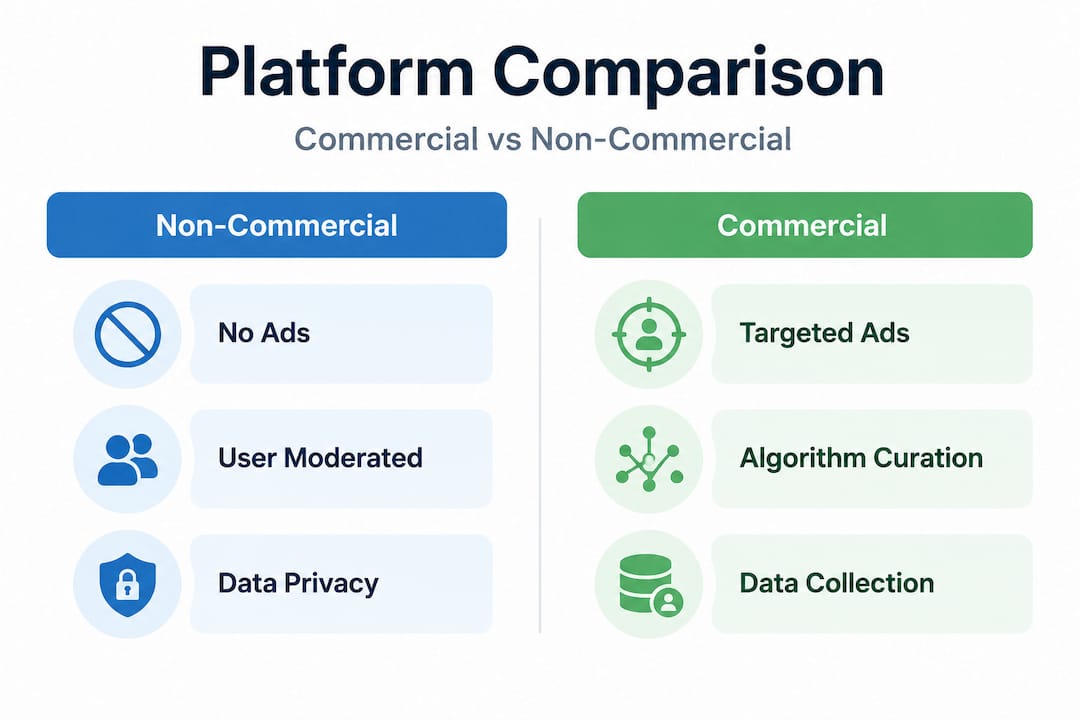
A useful benchmark for non-commercial content standards comes from a well-known public institution. Non-commercial channels prioritize education and inspiration, maintain G-rated content, and prohibit vulgar or off-topic comments to keep content suitable for all ages. While that policy applies to NASA's own accounts, it reflects a broader philosophy common across non-commercial and non-profit social media communities.
What this looks like in practice on community-governed platforms:
- Moderation is human, not purely algorithmic, meaning real community members review reported content
- Community guidelines are publicly posted and typically open to feedback from members
- Off-topic commercial posts are actively removed, not just deprioritized as they would be on commercial platforms
- Accessibility is valued, with many communities encouraging alt text for images and plain-language captions
Here is how non-commercial platform norms compare to commercial platform defaults:
| Feature | Non-commercial platforms | Commercial platforms |
|---|---|---|
| Content moderation | Human, community-led | Algorithm-first |
| Advertising | None | Central to experience |
| Data tracking | Minimal or none | Extensive |
| Content ownership | Retained by user | Often licensed to platform |
| Community rules | Set by members or instance admins | Set by corporation |
| Revenue model | Donations, grants, fees | Advertising and data |
Strong community management practices are what keep non-commercial spaces worth being in. When you remove the profit motive, what replaces it is direct accountability between members. That shift produces noticeably different conversations. The benefits of community-driven engagement are especially clear in photo-sharing spaces where authentic reaction matters far more than virality.
Tips for choosing and engaging with non-commercial social media platforms
Knowing what to expect from platform communities lets you engage meaningfully on non-commercial social media.
Picking the right platform takes more thought than signing up for a mainstream network. Here is a step-by-step approach:
- Research the platform's funding model. Donations, grants, and user fees are healthy signs. Advertising revenue is not.
- Read the instance or community rules before registering. Look for clear moderation policies and active enforcement.
- Check when the last moderation report was published. Active non-commercial online communities publish these regularly as a sign of transparency.
- Look at existing content. If the posts feel authentic and varied, that is a good signal. If everything looks like promotion, move on.
- Test the community before committing. Many decentralized platforms let you view public content without an account.
Users on federated platforms like Pixelfed must choose instances carefully, as each has independent moderators and community norms; interacting requires full handles like @user@instance.social. This is different from platforms where your username is just @yourname. Write down your full handle when you register because you will need it to be found by people on other instances.
| Consideration | What to look for | Red flag |
|---|---|---|
| Funding | Donations, grants, member fees | Advertising-dependent |
| Moderation | Active, human, transparent | Automated only |
| Content ownership | User retains rights | Platform claims license |
| Community size | Engaged and consistent | Inactive or purely promotional |
| Federation support | ActivityPub compatible | Closed, proprietary network |
Pro Tip: For photo-focused sharing, read up on photo-based social networking before choosing a platform. Understanding image formats and compression differences between platforms helps you post your best work. Pair that with the right visual creation tools and your photography will stand out from day one.
Why the conventional view of social media misses the value of non-commercial networks
Here is a fresh perspective on why non-commercial social media truly matters, and why the mainstream conversation gets it wrong.
Most discussions about social media choice focus on features: which app has better filters, which one has more users, which one is growing fastest. That framing entirely misses the structural issue. When a platform's revenue depends on advertising, every design decision eventually serves that revenue model. The feed, the notification system, the recommendation engine, the content policies: all of it bends toward keeping you engaged in ways that serve advertisers, not you.
Decentralization provides intimate community moderation and data control, avoiding profit-driven motives unlike centralized platforms. But the deeper point is about what happens to your content and your identity when economic incentives disappear from the equation. On a non-commercial platform, your photo of a village in Portugal or a market in Krakow is just that: a photo worth sharing. Nobody is extracting data from it to sell you something later.
The conventional view also underestimates what communities can do when members govern their own norms. Community-governed platforms consistently produce more thoughtful conversations about cultural content than algorithm-sorted feeds because the people making moderation decisions actually care about the community's character.
There is also an authenticity question that rarely gets discussed. On commercial platforms, even genuinely personal posts exist within an advertising environment that shapes how you perceive them. Non-commercial platforms remove that frame entirely. The result is not just privacy: it is a different quality of connection.
Explore non-commercial social media with Experience.eu
Now that you understand non-commercial social media, Experience.eu can help you join communities that value these principles.
Experience.eu is built around exactly what this guide describes: personal storytelling, photography, and cultural sharing without commercial pressure. You can post your experiences, connect with fellow Europeans, and explore a community that puts authentic connection first.
Whether you are looking for a welcoming space to share your photography or you want to learn more about ethical community building, Experience.eu has practical resources alongside its social network. Browse the non-commercial social network options to see what kind of communities are active and find your fit. For anyone managing or growing a community of their own, the platform's community management strategies offer grounded, experience-backed advice. Registration is free, and the community is genuinely glad to meet you.
Frequently asked questions
What exactly makes a social media account non-commercial?
An account is non-commercial if it is purely private with no advertising, product promotion, paid partnerships, or economic purposes, even indirectly. Only purely private accounts with no advertising, product recommendations, commissions, or other remuneration qualify.
Can I share my photography on non-commercial platforms without losing ownership?
Yes, especially on decentralized platforms like Pixelfed, where users retain control over content without ads or tracking. Pixelfed offers content ownership and control returned to the user as a core feature.
Are there content restrictions on non-commercial social media?
Non-commercial channels often enforce guidelines for educational, G-rated, and respectful content suitable for all ages to maintain safe communities. Non-commercial channels prioritize education and inspiration and prohibit vulgar or off-topic comments.
How can I participate in a decentralized social media community?
Choose an instance carefully, learn to use full user handles such as @user@instance.social, and respect the unique moderation and community norms of that network. Users on Pixelfed must understand that each instance has independent moderators and its own specific community standards.