

Your social feed is not a simple inbox of posts from people you follow. Most users assume that what they see is a direct reflection of who they've connected with, but that's only part of the picture. Algorithms quietly rank, filter, and inject content from beyond your network, deciding what you see first, what gets buried, and what suddenly feels like "everyone is talking about this." Understanding how this works puts you back in control, whether you're sharing travel photos, cultural moments, or community stories across Europe.
Table of Contents
- What is a social feed?
- How do algorithms decide what you see?
- Personalization and its impact on community trends
- Engagement metrics: Understanding your influence
- What most people miss: Feed research and algorithm challenges
- Our perspective: Navigating social feeds with purpose
- Take your social feed further with our resources
- Frequently asked questions
Key Takeaways
| Point | Details |
|---|---|
| Feeds are curated | Social feeds use algorithms to select and arrange posts from both your network and outside sources. |
| Algorithms shape influence | The order and content of your feed can shift attitudes, trends, and what gets community attention. |
| Engagement drives visibility | Increasing likes, comments, and shares makes posts appear more often and reach larger audiences. |
| Personalization affects culture | What you see in your feed impacts what you think of as relevant, trending, and culturally important. |
| Awareness empowers users | Understanding how feeds work lets you post, share, and engage with purpose and confidence. |
What is a social feed?
A social feed is a continuously updated stream of content on a social platform. It typically mixes text posts, photos, and videos in a single scrollable view. Simple enough, right? But the mechanics behind what fills that stream are anything but simple.
Your feed is not a chronological list of posts from your friends. It's a curated selection assembled by the platform's ranking system. That system pulls from multiple sources: people you follow, community pages, trending topics, and increasingly, accounts you've never interacted with. The goal is to keep you engaged as long as possible.
Here's what typically shapes what lands in your feed:
- Posts from followed accounts: Content from people or pages you've directly connected with
- Algorithmic recommendations: Posts from accounts outside your network that the platform thinks you'll enjoy
- Trending or popular content: Posts gaining rapid engagement across the platform
- Sponsored or promoted posts: Paid content inserted based on your interests and behavior
- Community or group content: Posts from groups, events, or cultural pages you've joined
"Feed mechanics and personalization can be studied and benchmarked indirectly via engagement metrics. Buffer's 2026 report analyzed tens of millions of posts to show median engagement differences across major platforms, revealing just how differently each feed environment performs."
Major platforms each handle feeds differently. Instagram leans heavily on visual signals and saves. TikTok prioritizes watch time above almost everything else. Facebook blends friend activity with group and page content. Pinterest focuses on interest categories. X (formerly Twitter) has been shifting toward a mix of followed accounts and algorithmically surfaced posts. If you're into social networking and photo sharing, understanding these differences helps you post smarter on each platform.
With the basics in mind, let's look at how these feeds are personalized for every user.
How do algorithms decide what you see?
Feed algorithms are ranking engines. They score every potential post and decide which ones to show you, and in what order. The inputs they use include your past behavior, the post's overall engagement, how recent it is, and how closely it matches your stated or inferred interests.

Here's a simplified breakdown of how major platforms rank content:
| Platform | Top ranking signals | Key differentiator |
|---|---|---|
| Saves, shares, time spent | Visual interest and relationship strength | |
| TikTok | Watch time, replays, shares | Completion rate is king |
| Comments, reactions, shares | Group and community activity weighted | |
| X | Replies, retweets, link clicks | Recency and trending topics |
| Saves, clicks, visual match | Interest category alignment |
What makes social feed algorithms genuinely surprising is their causal power. Research published in Science found that feed-ranking algorithms can causally affect user outcomes, including attitudes. Reranking interventions on X produced measurable shifts in affective polarization (how strongly users feel opposed to different groups) when exposure to certain content was increased or decreased. That's not a small effect. That's the algorithm shaping how people think.
Statistic to know: Engagement is the primary currency of feed visibility. Posts with more likes, comments, and shares get pushed to more people, which generates even more engagement. It's a compounding effect that rewards content that already performs well.
Pro Tip: Post when your audience is most active. Algorithms factor in recency, so a post that gets fast early engagement has a much better chance of being surfaced widely. Check your platform analytics to find your best posting windows.
One more thing worth knowing: algorithms are not neutral. They're designed to maximize time on platform, which means they favor content that provokes strong reactions. Understanding this helps you learn to increase Instagram engagement intentionally, rather than accidentally feeding the algorithm what it wants at your expense.
Now that we understand algorithms drive the feed, what does this mean for what you actually see and do online?
Personalization and its impact on community trends
Here's where things get genuinely interesting for anyone sharing cultural experiences or building community online. Algorithms don't just personalize your feed for you individually. They shape what entire communities consider relevant, popular, or worth talking about.
Think about it this way. Two people in the same city, both interested in European street photography, may follow the same 50 accounts. But their feeds can look completely different based on their individual engagement histories. One person sees a post from a new photographer go viral in their feed. The other never sees it at all. The algorithm decided who got exposure and who didn't.
This has real consequences:
- Community fragmentation: Even within tight-knit groups, members may develop different ideas of what's trending based on what their individual feeds surface.
- Out-of-network exposure: Algorithms regularly inject content from accounts you don't follow, which can introduce fresh perspectives but can also dilute the sense of a shared community experience.
- Trend amplification: When a post gets traction, the algorithm pushes it further, making it feel like "everyone" is talking about it, even if the original audience was small.
- Cultural gatekeeping: The algorithm effectively decides which creators, voices, and stories get amplified and which stay invisible.
Tracking understanding engagement metrics alongside reach and impressions helps you see how your content is performing within this feed environment, not just how many people liked it. According to the FIU CORE blog, monitoring reach and impressions alongside engagement gives creators a clearer picture of how feed ranking is affecting their visibility.
A comparison of what different metrics actually tell you:
| Metric | What it measures | Why it matters for feeds |
|---|---|---|
| Reach | Unique accounts that saw your post | Shows how far the algorithm pushed your content |
| Impressions | Total times your post was displayed | Reveals repeat exposure and feed placement |
| Engagement rate | Interactions divided by reach | Indicates content quality and algorithm favor |
| Saves | Users bookmarking your post | Strong signal for Instagram's ranking system |
| Shares | Users forwarding your post | Expands reach beyond your direct followers |
As Tweet Archivist notes, feeds mix content from followed accounts with out-of-network recommendations, meaning users regularly see material beyond their direct connections. If you're sharing photos and cultural stories, boosting natural engagement is one of the most effective ways to ensure your content reaches the right community.
Let's put these themes into context by reviewing how engagement metrics work and why they matter for young content creators and community members.
Engagement metrics: Understanding your influence
Engagement metrics are the numbers that tell you how people are responding to your content. But more importantly, they're the signals that tell algorithms how to treat your posts going forward. High engagement equals higher visibility. Low engagement means your post gets buried.
Here's a quick breakdown of the core metrics:
- Likes: The most basic signal. Easy to give, but still counted by algorithms as a positive indicator.
- Comments: Weighted more heavily than likes on most platforms because they require more effort and signal genuine interest.
- Shares: One of the strongest signals. When someone shares your post, they're vouching for it to their own audience.
- Saves: Particularly important on Instagram. Saving a post signals that the content has lasting value.
- Reach: How many unique people saw your post. A post can have high reach but low engagement, which signals the content didn't connect.
- Impressions: Total views, including repeat views. High impressions with low reach means the same people are seeing it multiple times.
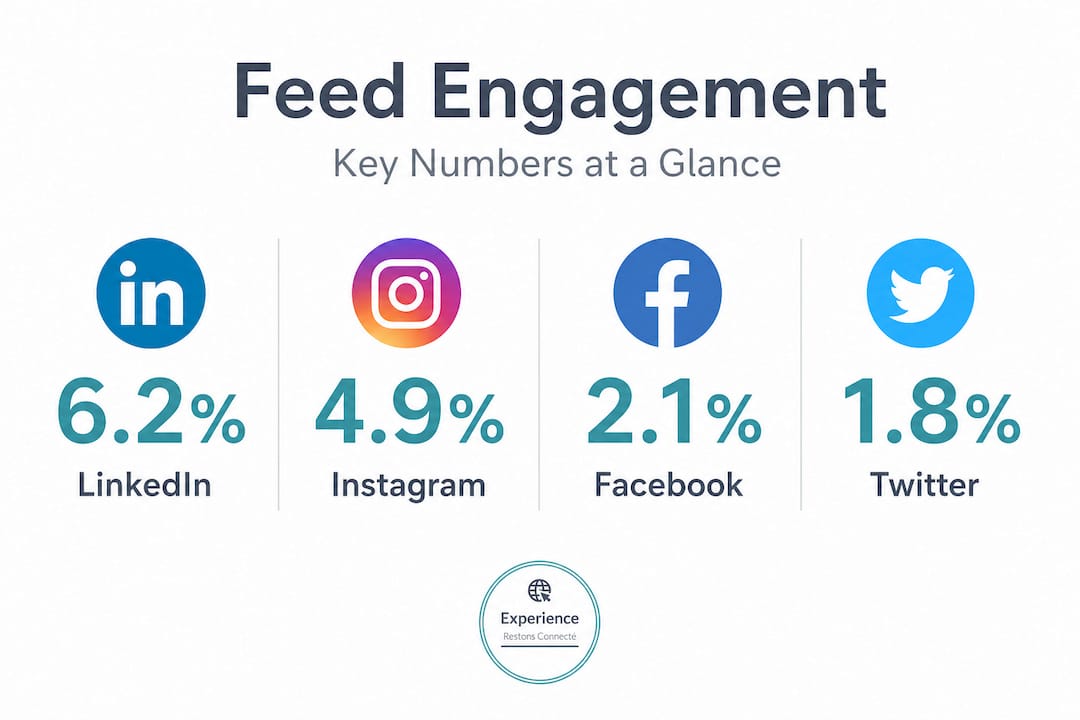
According to Buffer's 2026 report, median engagement rates vary significantly across platforms: LinkedIn leads at 6.2%, followed by Facebook at 5.6%, Instagram at 5.5%, TikTok at 4.6%, Pinterest at 4.0%, and X at 2.5%. These numbers matter because they set the benchmark for what "good" looks like on each platform.
Pro Tip: Don't chase likes. Focus on comments and shares. A post with 20 comments will almost always outperform a post with 200 likes in the algorithm's eyes, because comments signal a real conversation is happening.
Using engagement strategies tailored to each platform, combined with using effective hashtags, gives your content the best chance of being picked up and amplified by the feed algorithm. Hashtags help platforms categorize your content and surface it to users with matching interests, even if they don't follow you yet.
With this understanding, it's also important to know what factors and pitfalls researchers notice when investigating feed impacts.
What most people miss: Feed research and algorithm challenges
Here's something even experienced social media users often overlook. Understanding the algorithm is one thing. Measuring its actual impact is much harder, even for researchers.
"Algorithmic effects are difficult to infer from simply turning feeds off. Causal identification can require interventions such as reranking because impacts may be long-term or mediated by other factors." T-Invariant
What does this mean in practice? A few important things:
- Turning off the algorithm isn't a clean fix. Some platforms offer a "chronological feed" option, but users who switch often revert because the algorithm-driven feed feels more relevant.
- Long-term effects are subtle. The algorithm's influence on your attitudes and preferences builds gradually. You may not notice it happening until your perspective has already shifted.
- Reranking experiments reveal real power. Studies that change what content gets shown to users demonstrate that these shifts produce measurable changes in how people feel about topics, communities, and other groups.
- Even expert users are not immune. Knowing how algorithms work doesn't make you immune to their influence. Awareness helps, but the system is designed to be engaging at a level that bypasses conscious filtering.
- Feed design shapes culture. Who gets seen, whose stories get amplified, and what content gets rewarded are all decisions baked into the algorithm. These choices have cultural consequences that extend far beyond any individual user's experience.
If you want to stay visible despite these invisible forces, optimizing your Instagram bio is a practical starting point. A clear, keyword-rich bio helps the algorithm categorize your account and surface it to the right audience.
Having deconstructed every layer of the social feed, let's synthesize with a perspective that helps you make sense of it all.
Our perspective: Navigating social feeds with purpose
Most conversations about social feeds focus on tactics: post at this time, use these hashtags, write this kind of caption. That's useful. But we think the more important conversation is about awareness.
Your feed is not a neutral window onto the world. It's a curated environment shaped by decisions you didn't make, optimized for goals that may not align with yours. Every scroll is a small negotiation between what the algorithm wants to show you and what you actually want to see.
Here's what we believe: every like, comment, and share you give is a vote. You're voting for what gets amplified in your community. When you engage with thoughtful, creative, culturally rich content, you're telling the algorithm to surface more of it. When you mindlessly engage with outrage or low-effort content, you're voting for more of that instead.
The most interesting users we see on platforms like ours are not the ones who post the most. They're the ones who engage with intention. They comment meaningfully. They share content that reflects the culture and community they want to build. They use the system rather than letting the system use them.
Understanding media literacy articles and how feeds work is not just a tech skill. It's a cultural skill. If you're sharing your experiences across Europe, posting photos of places and moments that matter to you, you deserve to understand the environment your content lives in. That knowledge makes you a more effective storyteller and a more mindful community member.
Don't let the feed shape your perspective without your awareness. Learn the system, then use it to amplify the stories and voices that matter to you.
Take your social feed further with our resources
Ready to put this knowledge into action? At experience.eu.com, we've built a space specifically for people who want to share their experiences, connect with a wider European community, and grow their presence through genuine engagement.
Explore our social network tools to connect with others who share your passion for culture, travel, and community storytelling. Fine-tune your profile with our guide to Instagram bio optimization so the algorithm works in your favor from the moment someone discovers you. And when you're ready to grow your reach, our resources on how to boost your engagement give you practical, platform-specific strategies to get your posts seen by the right people. Join the community. Share your story. Make your feed work for you.
Frequently asked questions
Do social feeds only show posts from accounts I follow?
No. Most social feeds now blend posts from your connections with recommendations from outside your network based on algorithmic relevance, meaning you regularly see content from accounts you've never followed.
Why do some posts go viral while others don't in my feed?
Posts go viral when algorithms detect high early engagement and push them to larger audiences. According to Buffer's 2026 report, engagement rates vary significantly by platform, and content that performs above the median benchmark is far more likely to be amplified widely.
Can algorithms in my feed influence my opinions or behavior?
Yes. Research published in Science shows that feed-ranking algorithms can causally shift user attitudes, with reranking experiments on X producing measurable changes in affective polarization among users.
How can I improve my visibility in social feeds?
Focus on generating comments and shares rather than just likes, as these carry more weight with most algorithms. Posting consistently when your audience is active and using relevant hashtags also signals to the platform's ranking system that your content deserves wider distribution.