

You scroll through your feed, double-tapping photos that deserve real conversation, but the comments are empty or generic. You want feedback that actually helps you grow. You want people who get it. Building your own photo community fixes that problem, and it is more achievable than you think. This guide walks you through every stage, from defining your vision and choosing platforms to growing engagement, maintaining a positive culture, and even generating income. Whether you are into street photography, travel shots, or European cultural heritage, these steps give you a clear path forward.
Table of Contents
- Clarifying your vision and preparing to launch
- Building engagement and growing your community
- Facilitating interaction and maintaining a positive culture
- Monetizing and sustaining your photo community long-term
- What most guides miss about building real photo communities
- Connect and grow your photo community today
- Frequently asked questions
Key Takeaways
| Point | Details |
|---|---|
| Start with a clear vision | Define your community's purpose and audience before launching. |
| Prioritize engagement | Regular posting, challenges, and authentic interaction are keys to growth. |
| Cultivate a positive culture | Active moderation and encouragement keep your group welcoming and vibrant. |
| Monetize thoughtfully | Offer real value if introducing paid memberships or exclusive content. |
Clarifying your vision and preparing to launch
Once you recognize the need for authentic, supportive connections, the next step is setting a strong foundation for your community's launch. Before you post a single invite or create a group, you need to know exactly what your community stands for. A blurry vision attracts the wrong people and burns out the founder fast.
Start by answering three questions: What is the main purpose of your community? Who is your ideal member? What does success look like in six months? Your purpose could be learning new techniques, sharing travel photography, or celebrating heritage photography in Europe. Each purpose attracts a very different crowd, so be specific.
Here is a quick overview of common community types and what they need:
| Community type | Primary goal | Key resource needed |
|---|---|---|
| Learning and critique | Skill growth | Experienced moderators |
| Cultural and travel | Shared experiences | Location-based themes |
| Challenge-based | Consistency and fun | Weekly prompts |
| Professional networking | Career growth | Industry guest speakers |
Once your purpose is clear, gather your essentials before launch:
- Platform choice: Pick one primary platform to start (Instagram, Facebook Group, or a dedicated site)
- Community guidelines: Write simple, positive rules before you open the doors
- Moderation plan: Identify one or two trusted people to help you manage early conversations
- Content starter pack: Prepare at least ten posts or prompts ready to go on day one
- Feedback loop: Set up a simple way for members to share suggestions early on
The photo community strategies that work long-term always start with clarity. One real-world example: the Travel Photography Club prioritizes connection over content, with confidence growing naturally in judgment-free spaces and in-person meetups planned as the community matures.
Pro Tip: Resist the urge to grow fast. A small group of ten genuinely engaged members is worth more than five hundred silent followers. Focus on relationships and encouragement over competition from day one.
Building engagement and growing your community
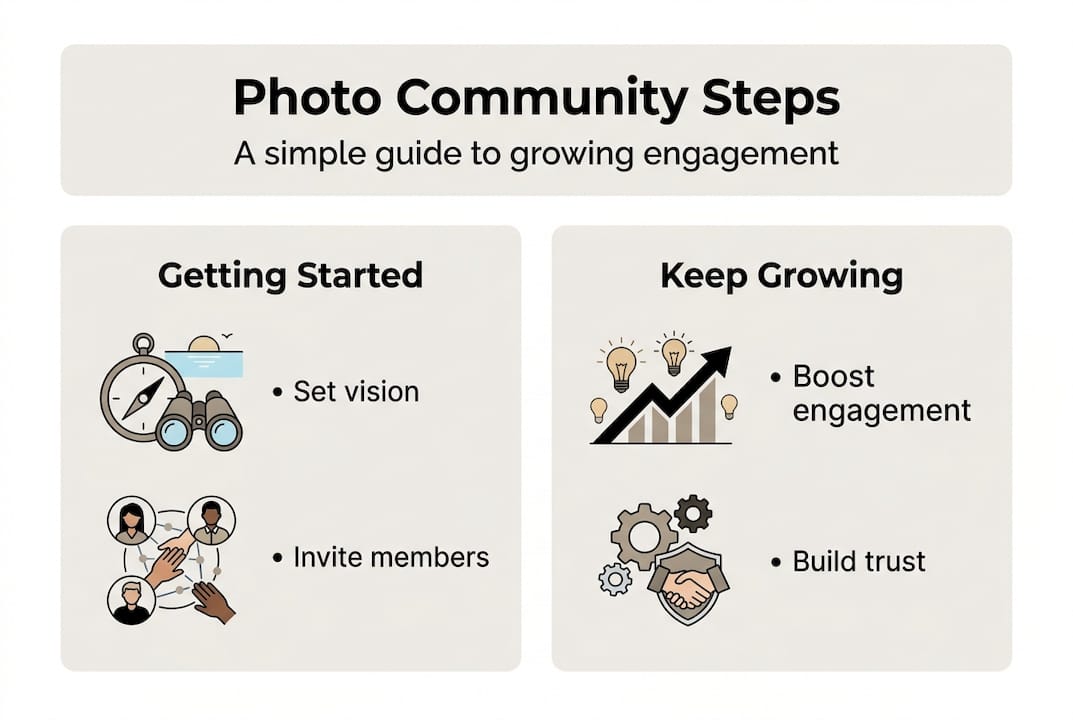
After you have defined your vision and organized your resources, it is time to invite others and spark real interest in your group. Engagement does not happen by accident. It is built through consistent habits and smart structure.
Here is a step-by-step approach to growing an active community:
- Set a posting schedule. Aim for three to five posts per week. Consistency signals that your community is alive and worth joining.
- Launch a weekly photo challenge. Themed challenges give members a reason to post and interact regularly.
- Spotlight user-generated content. Feature a member's photo each week. People stay where they feel seen.
- Respond to every comment early on. Your energy sets the tone. If you engage, others follow.
- Host Q&A sessions. Live or async Q&As build trust and deepen connections between members.
Not every platform works the same way. Here is how the top three compare for photo community building:
| Platform | Strengths | Best use case |
|---|---|---|
| Visual reach, Reels, Stories | Brand building and discovery | |
| Facebook Groups | Deep discussions, events, polls | Community hub and retention |
| Evergreen content, boards | Inspiration and resource sharing |
The most effective approach is to build on Instagram with a consistent visual identity and active engagement, then expand to Facebook Groups for deeper conversations and Pinterest for curated inspiration boards.
"Photo challenges boost participation and user-generated content increases authenticity far more than polished brand posts ever could."
For growing a photo network, the key is adapting based on what your data tells you. Check which posts get the most saves, shares, and comments, then do more of that.

Pro Tip: Use your platform's built-in analytics every two weeks. Look at reach, saves, and comment depth, not just likes. These numbers tell you what your members actually value.
Also check out these boosting engagement tips from real community photography projects for more proven tactics you can apply right away.
Facilitating interaction and maintaining a positive culture
Strong growth brings diversity and new voices, and this is where active facilitation and clear values become essential. A community without culture is just a feed. Culture is what keeps people coming back.
Start with clear, positive rules. Your guidelines do not need to be long, but they do need to be visible and enforced consistently. Here are the core elements every photo community should address:
- Respect and encouragement: No harsh criticism without consent; frame feedback constructively
- Content standards: Define what types of photos are welcome and what is off-limits
- Conflict resolution: Explain how disputes are handled and who to contact
- Spam and self-promotion rules: Set clear limits so the feed stays valuable
- Inclusivity statement: Make it clear that all skill levels and backgrounds are welcome
As your community grows, create sub-groups organized by location, style, or interest. A European street photography thread and a nature photography thread serve very different needs. Giving members a smaller space to belong to actually increases their loyalty to the larger group.
The community engagement tips that matter most are the ones that center human connection. Research from 52Frames shows that weekly themes foster consistency without pressure, and that focusing on relationships over competition is what separates communities that last from those that fade.
"Confidence grows when people share without fear of judgment. The best photo communities are the ones where a beginner feels as welcome as a professional."
Moderate fairly and act quickly when issues arise. Letting a negative interaction sit unaddressed sends a message to every member watching. Your response time to conflict is one of the clearest signals of how much you value your community.
Monetizing and sustaining your photo community long-term
With an active, trusted community, you may start considering how to keep it thriving and even generate income to offset costs or fund bigger projects. Monetization done right feels like added value, not a paywall.
Here are the most effective revenue models for photo communities:
| Revenue model | Example | Typical monthly income |
|---|---|---|
| Premium membership | Exclusive critiques, early access | $5 to $30 per member |
| Online workshops | Live editing sessions, guest experts | $50 to $200 per event |
| Sponsored challenges | Brand-themed photo contests | $500 to $5,000 per campaign |
| Digital downloads | Presets, guides, templates | Variable |
52Frames is one of the most inspiring examples: it grew from Facebook challenges to a global community generating $10,000 in monthly revenue through premium memberships, driven entirely by organic growth and consistent feedback loops. Similarly, The Photo Managers built an $800K annual community using a membership model built around shared professional passion.
Follow these steps to launch premium options without alienating your free members:
- Survey your community first. Ask what they would pay for before you build it.
- Start with one paid offering. A single workshop or monthly critique session is enough to test demand.
- Keep the free tier valuable. Paying members should get extras, not the basics that made your community worth joining.
- Be transparent about pricing. Explain clearly what the money supports.
- Gather feedback after every paid event. Iterate fast based on what members tell you.
Sustaining long-term growth means you never stop listening. Run quarterly surveys, celebrate community milestones, and keep evolving your content mix. Communities that stay static eventually lose momentum.
What most guides miss about building real photo communities
Before wrapping up, let's get real about what matters beyond the typical how-to checklists. Most articles focus on platform tactics and posting schedules. Those things matter, but they are not what makes a community last.
The truth is that social media platforms give you reach, but they do not give you resilience. Algorithms change. Platforms decline. If your entire community lives inside one app, you are one policy update away from losing everything. Building an owned channel, whether that is a newsletter, a dedicated website, or a private forum, gives your community a home that belongs to you.
More importantly, the why behind your community outlasts any tool or trend. Members do not stay because of a great Instagram grid. They stay because they feel connected to a shared purpose and to each other. Offline meetups, local photo walks, and collaborative projects create bonds that no algorithm can replicate.
The real community lessons that experienced founders share again and again come down to one thing: authentic relationships beat growth hacks every single time. A community of 200 people who genuinely care about each other will outlast and outperform a group of 20,000 passive followers.
Pro Tip: Start a simple monthly newsletter for your community. Even a short roundup of member photos and upcoming events builds a habit of connection that lives outside any single platform.
Connect and grow your photo community today
Ready to apply these insights and launch your own thriving photo community? You do not have to start from scratch alone.

The Social Network platform at experience.eu.com gives you a ready-made space to share your photos, connect with other passionate photographers across Europe, and build real relationships around shared cultural experiences. Registration is completely free, and the community is already active and welcoming. While you build your own group, join our community to find your first collaborators, get inspired by what others are sharing, and start posting today. Your next great connection is one photo away.
Frequently asked questions
What platforms are best to start a photo community on?
Instagram is ideal for quick growth and visual discovery, while Facebook Groups and Pinterest offer deeper discussions and better long-term organization for active members.
How often should I post to keep my community engaged?
Aim to post 3 to 5 times per week and use themed photo challenges to encourage regular participation and keep energy levels high.
Can a photo community generate income?
Yes, communities like 52Frames earn through premium memberships and events, reaching $10,000 per month by focusing on organic growth and consistent member value.
How do I keep my photo community safe and positive?
Set clear guidelines from day one, moderate actively, and encourage supportive, judgment-free feedback so every member feels confident sharing their work.